Octopus Anatomy: External and Internal Body Parts of the Octopus
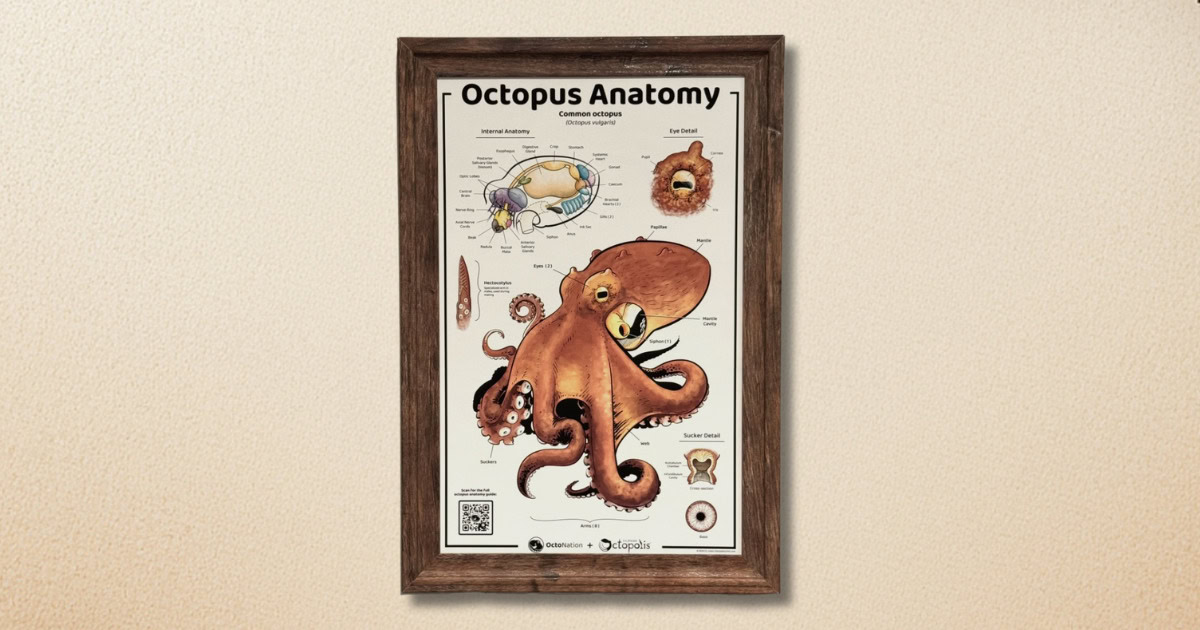
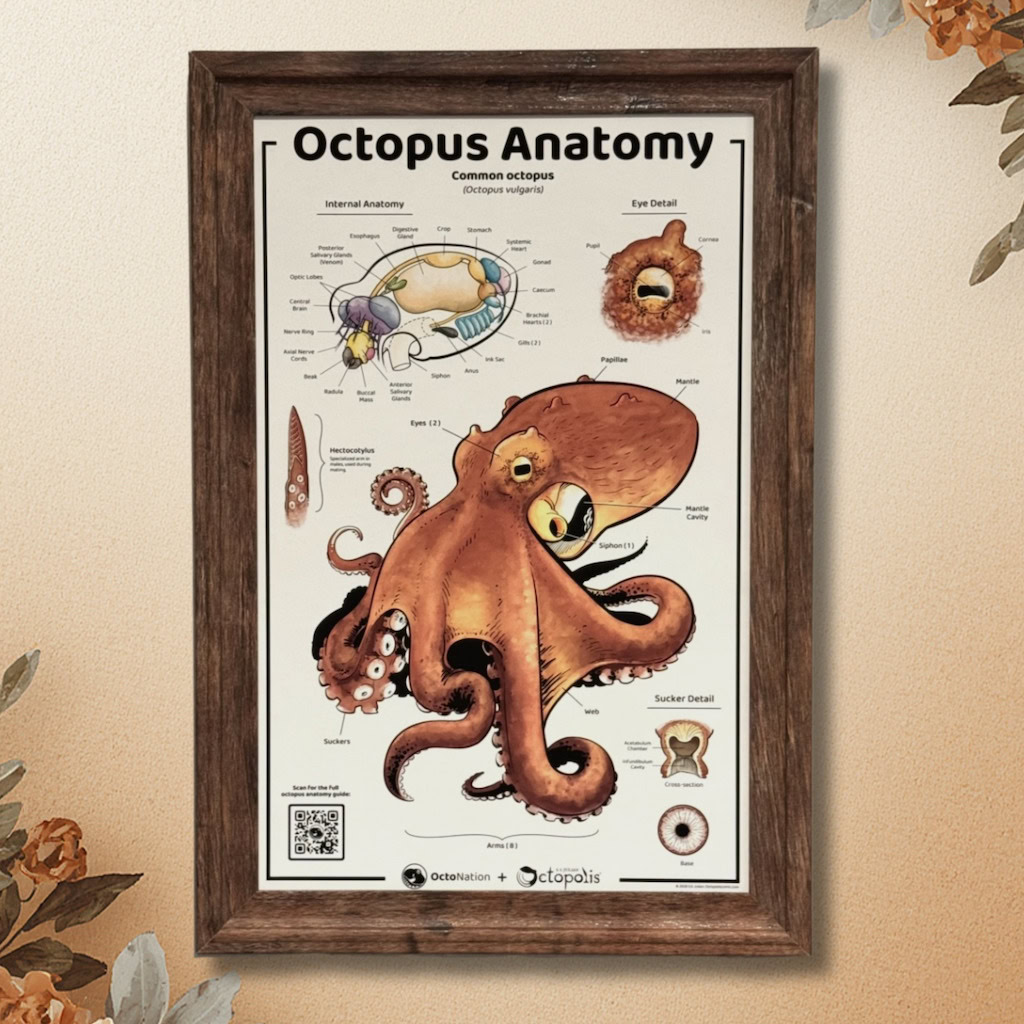
Most folks know that octopus have three hearts, eight arms, and blue blood…but that’s just the start! We connected our resident marine biologist Dr. Chelsea Bennice with artist S.S. Julian & they collaborated to bring you our first ever octopus anatomy poster! Here’s everything you need to know about octopus anatomy! If you’re looking for the art print, buy it here!
📋 Table of Contents [click to expand]
Table of contents
- First Things First…Octopuses Are Not Aliens
- What is an Octopus?
- Octo-Overview: Parts of an Octopus at a Glance
- Beauty is Skin Deep
- Call to Arms
- Caught in the Web
- Suction Section
- Male and Female
- The Eyes Have It
- Inside the Octopus
- Where Internal Meets External: The Mantle and Siphon
- Stranger Things: Mouth Parts
- Brain Power
- Hearts and Gills: Pump It Up
- Ink-credible Escape
- Eat, Digest, Repeat
- The Birds and the Bees – Ovaries & Testes
- Octopuses – They’re Endlessly Fascinating!
- Octopus Anatomy: Thank you for Reading!!!
- Who is the Octopus Anatomy Artist?!
- Continue Exploring Octopus Anatomy!
First Things First…Octopuses Are Not Aliens
Octopus biology is fascinating because it’s so different from our own. Some would rush to say alien, but we know better! Scientists estimate our last common ancestor was a worm-like creature wriggling across the ancient seafloor around 600 million years ago. Humans have been around for a few hundred thousand years. Cephalopods? Half a billion.
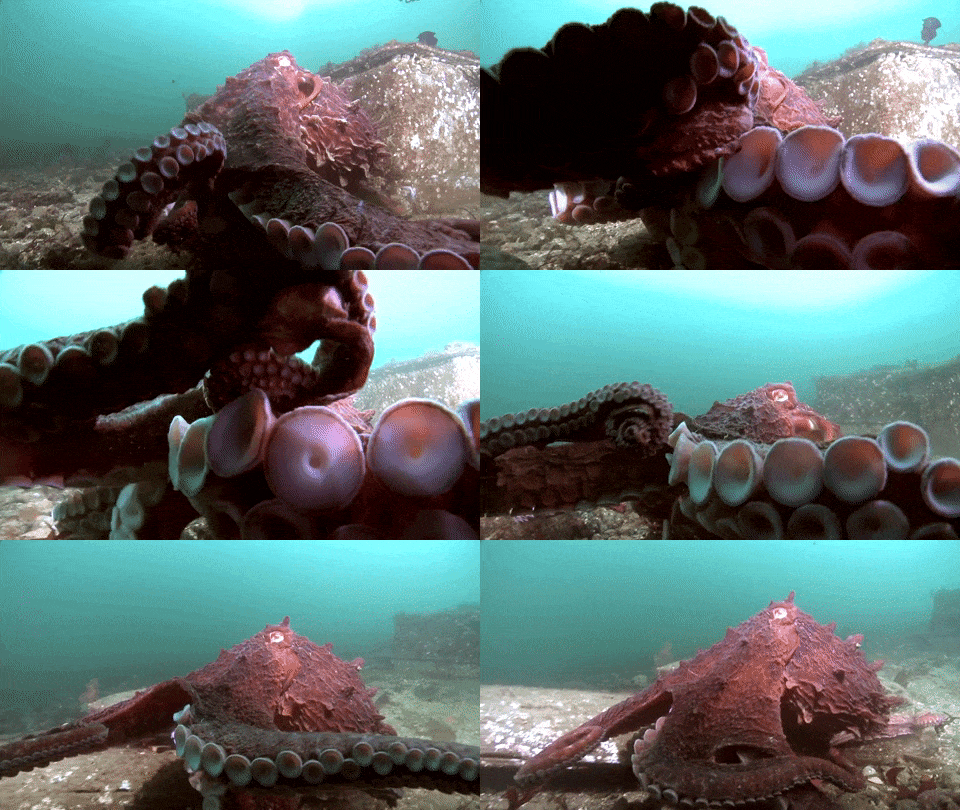
So no, octopuses aren’t extraterrestrial. They’re extremely from Earth. Earth’s OGs. We’re even cool with you callin’ them earth’s original weirdos (cuz we embrace weird here!)
The ocean isn’t a big blue blanket on Earth’s surface. It’s a stacked living world. From sunlit shallows to the deep dark zones below, life is layered through the water column in ways we’re still trying to understand. Next time you look up at all that open air, imagine it filled with drifting, swimming, glowing, hiding, hunting life in every direction!
These are our oceans OctoNation! A bustling, living planet under the waves!
Octopuses represent a lineage that goes back long before dinosaurs were the main characters. Their ancestors survived ancient oceans, global shakeups, and mass extinction events that wiped out entire branches of life.
So yeah, calling octopuses “aliens” is fun, but disconnects us from them. Let’s not make the octopus an outsider in its own ocean home!
They didn’t come from outer space. They were here first.
(Let’s face it humans are the new, noisy kids on the block in terms of time on this planet) 😅
Now let’s explore what makes these squishy cephalopods so incredible!!!
If you’d like to buy the print below, it’s available here for sale
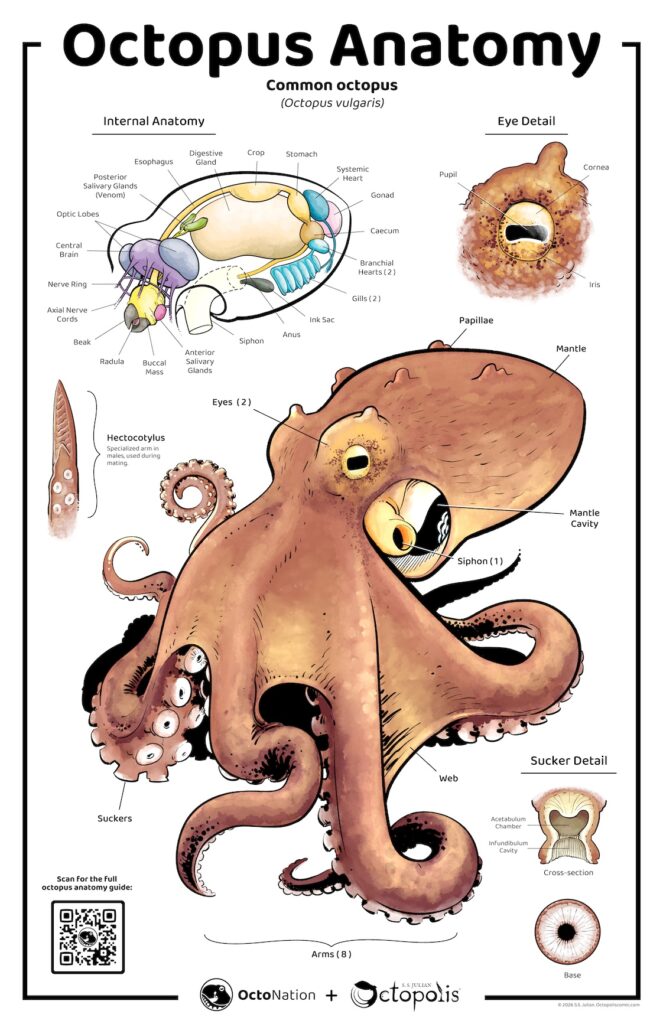
What is an Octopus?
Octopuses are soft-bodied marine animals with skin that changes color AND texture in a blink, brains that solve puzzles, open jars, and recognize individual humans…and guess what? They even had ancestors that were already ancient before the first dinosaur even hatched! Take that Jurassic Park!
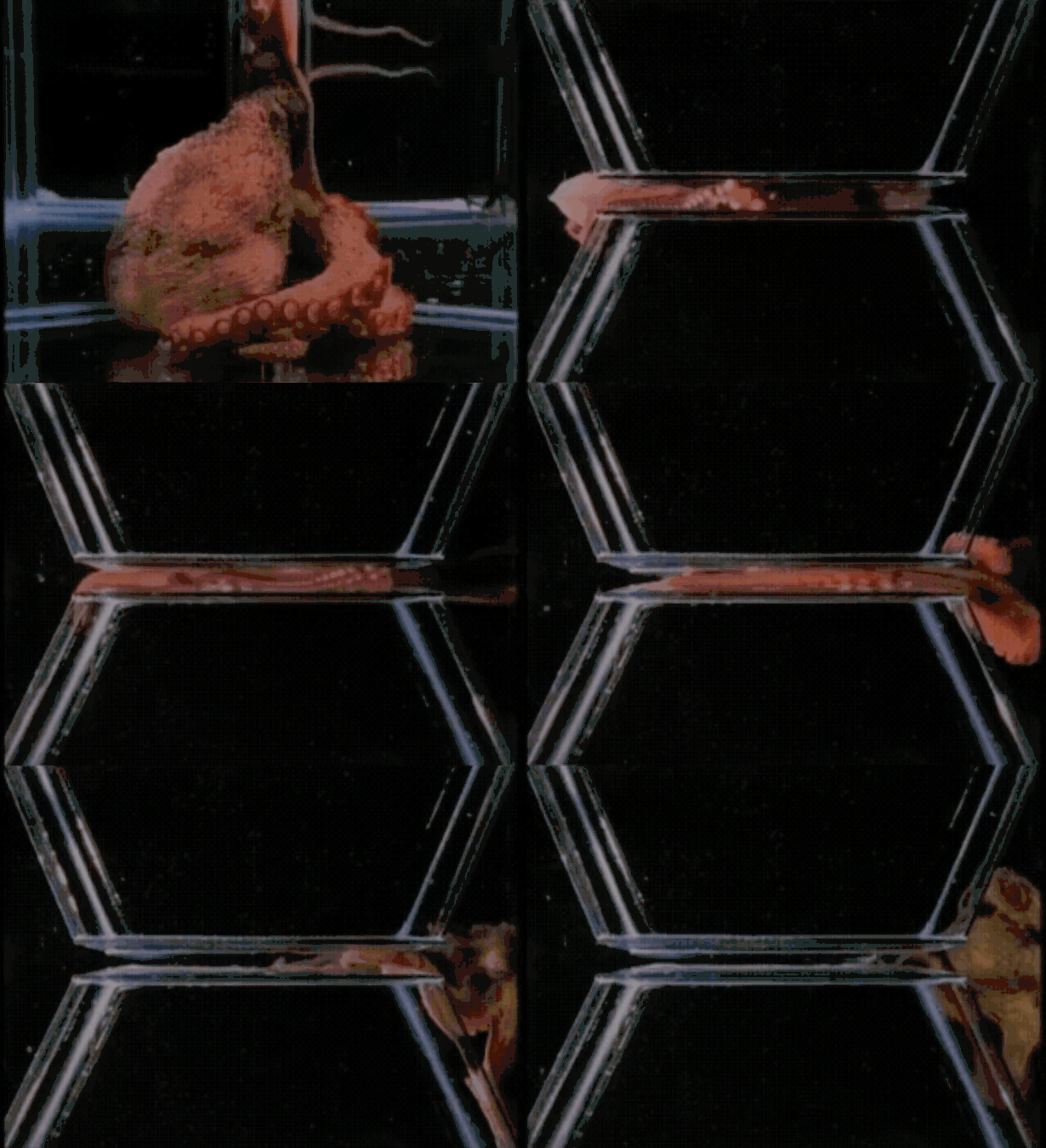
Unlike us vertebrates, octopuses are invertebrates, meaning zero backbone. The only hard part of an octopus is its parrot-like beak. So if that beak fits, the rest of them fits.
Check it out:
They belong to the phylum Mollusca (muh-LUS-kuh), the squishy-but-mighty crew that also includes squid, snails, and clams.
Most mollusks share three signature features: a mantle (the muscular “cloak” that holds their organs), a foot (which in octopuses evolved into eight arms AND the funnel they use for jet propulsion), and a radula (RAD-yoo-luh), a tiny ribbon-tongue covered in teeth that helps shred and pull food into the mouth.
Octopus are in a subgroup called Cephalopoda which means “head-foot.” Why that name? Because in octopuses, the muscular foot has evolved into their eight flexible arms attached to their head!
Octo-Overview: Parts of an Octopus at a Glance
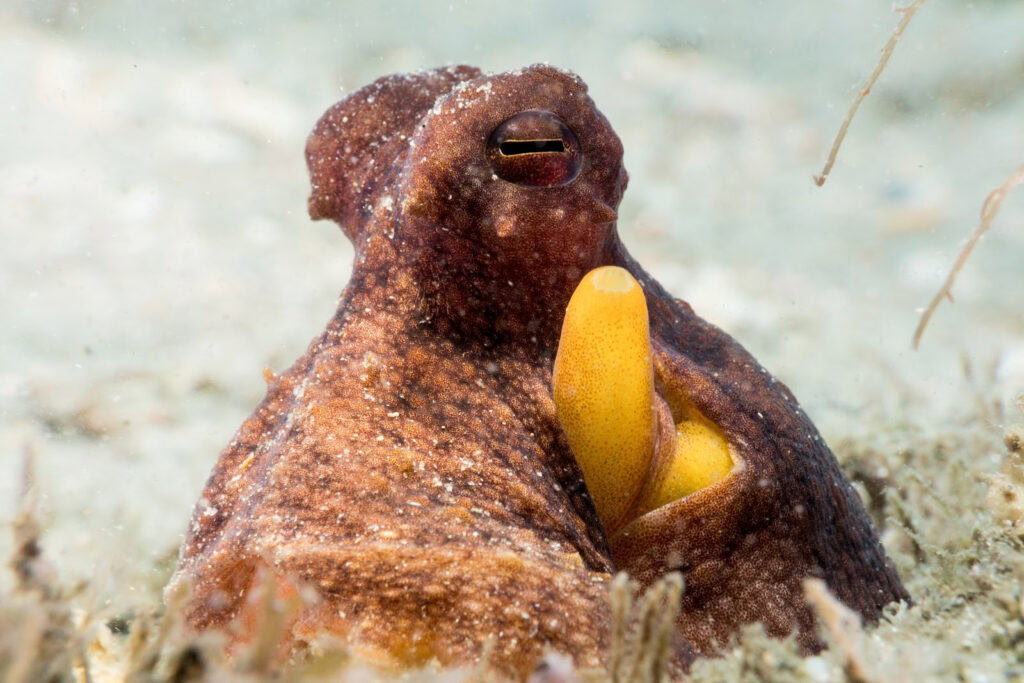
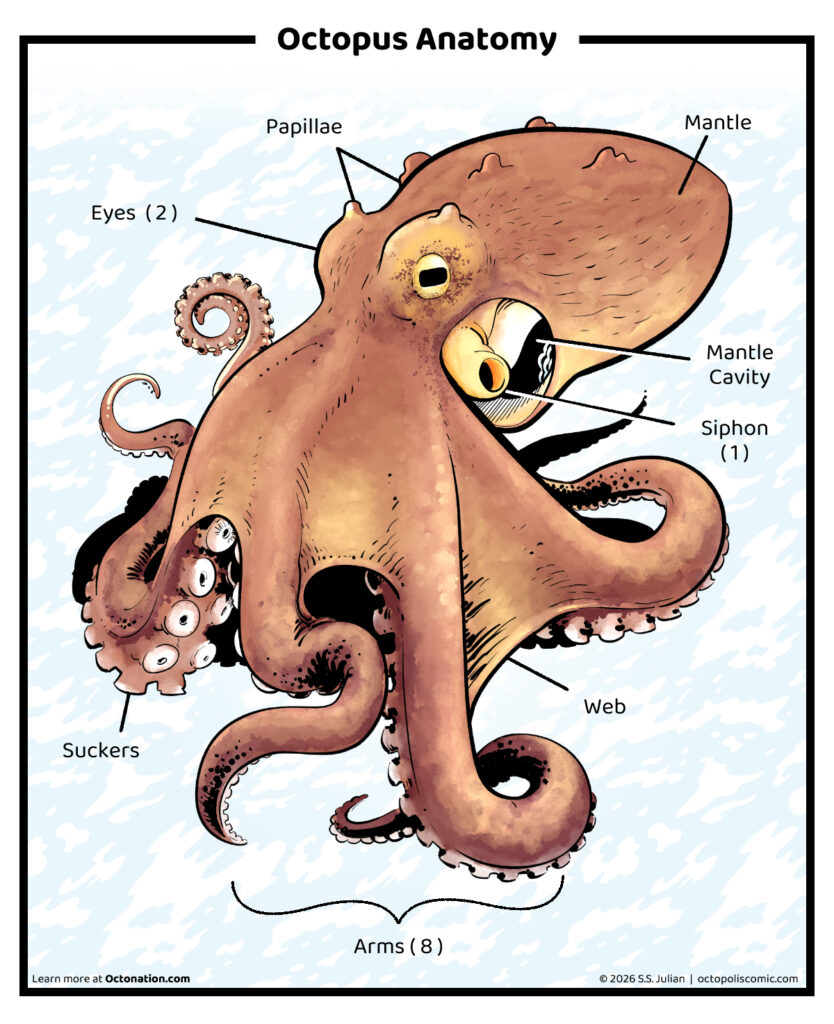
An octopus’s body might appear simple, but it’s truly a marvel of evolution. Its head features two bulbous, well developed eyes. Just behind the head is the mantle – a rounded, balloon-like body part that can expand with water and also houses vital organs, including the hearts, gills, stomach and ink sac.
Extending from the head is a crown of eight flexible arms, lined with suckers, used for movement, sensing, and capturing prey. At the center of these arms is the mouth, which contains the beak and the radula mouth parts optimized for cracking open shells and munching on tasty snacks.
Beauty is Skin Deep
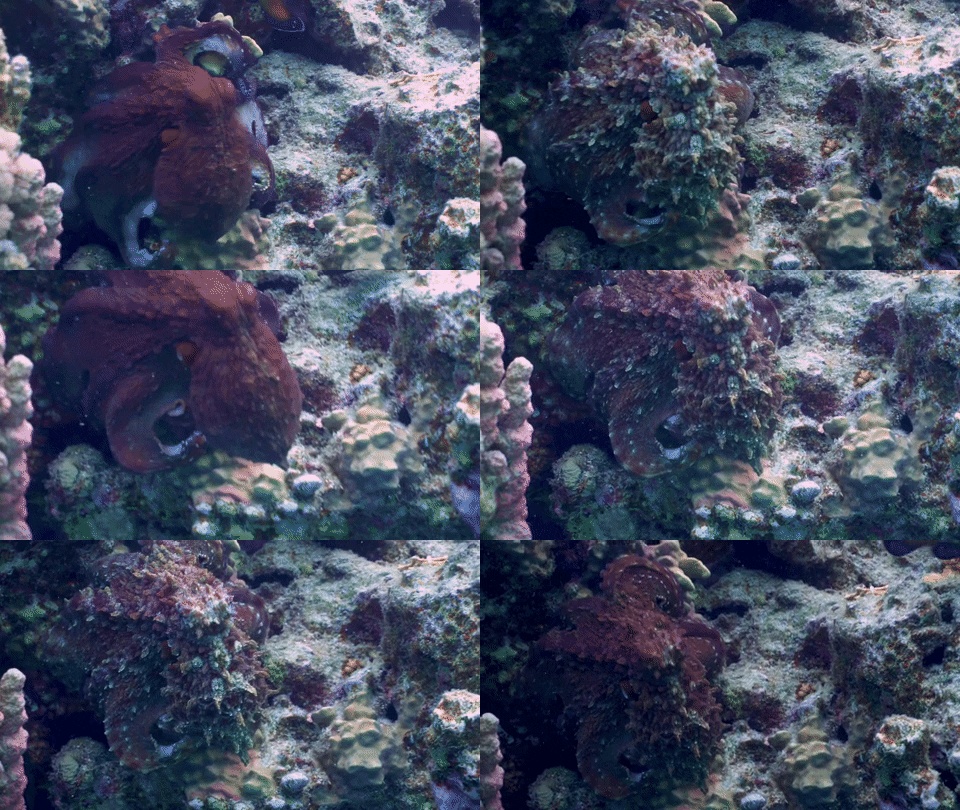
Octopus Skin: How Chromatophores and Papillae Change Color and Texture
Octopuses are famous for their mesmerizing ability to transform and that’s thanks to their spectacular skin, large nervous system, and muscles. #OctoGains 💪🐙
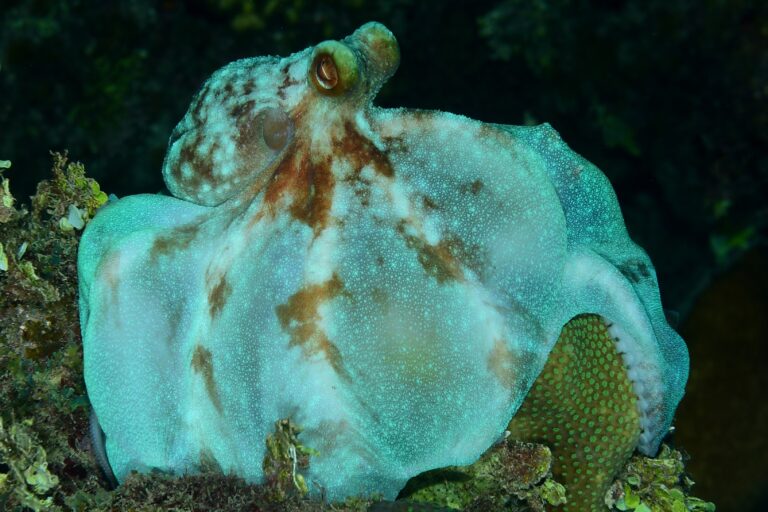
Their skin works like a living mood ring and camouflage suit all in one. Octopus skin is covered with color-changing cells called chromatophores, along with texture-changing muscles called papillae that can make the skin bumpy or smooth on demand!
Together, octopuses use this built in disguise system, like wearing an instant shape-shifting costume for camouflage or to send signals and communicate with other animals.
Call to Arms
Octopus Arms (Not Tentacles): Anatomy and How They Move Without Bones
The octopus’s arms are its Swiss Army limbs, used for sensing the environment, capturing prey, moving, defense, and even communication!
Octopuses have eight arms and no tentacles. That’s right! Tentacles are specialized feeding appendages found in other cephalopods like cuttlefish and squid who have 8 arms and 2 tentacles.
Though octopus arms appear extremely stretchy, they don’t extend like elastic bands. Instead, they move through powerful muscles — similar to how our own arms work. The big difference…without bones!
Their arms, along with the rest of their body, are made up of muscular hydrostats, structures packed with muscle tissue. They rely on the incompressibility of muscle, which are mostly made up of water, for support because they do not have a bony skeleton. Other examples of a muscular hydrostat include your tongue and an elephant’s trunk!
For the arms to change shape at a constant volume, certain muscle groups have to contract while others relax. Octopus arms contain four main muscle groups, transverse, circular, longitudinal, and oblique, that together allow the arms to elongate, shorten, and twist, giving incredible control and flexibility.
Caught in the Web
The Octopus Web: Stretchy Skin Between the Arms
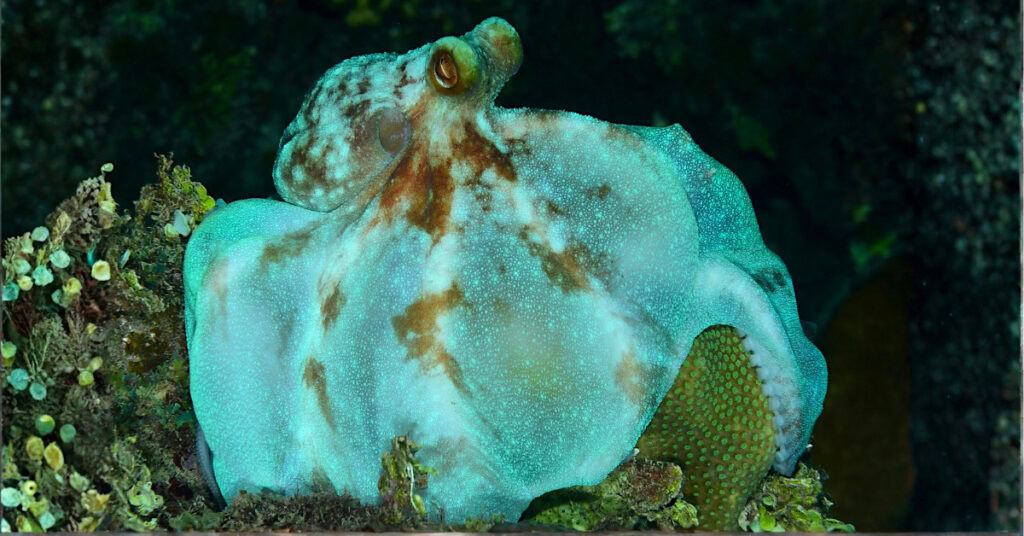
The web is the stretchy skin and muscle that connects an octopus’s arms — like fabric stretched between the spokes of an umbrella. Depending on the species, this webbing can be short or extend almost all the way to the tip of their arms.
When spread out, it works a bit like a net or parachute, helping the octopus wrap around and trap prey. For self defense, they can also flare their web to look larger and more intimidating to predators.
Suction Section
How Octopus Use their Suckers to Taste & Explore their World
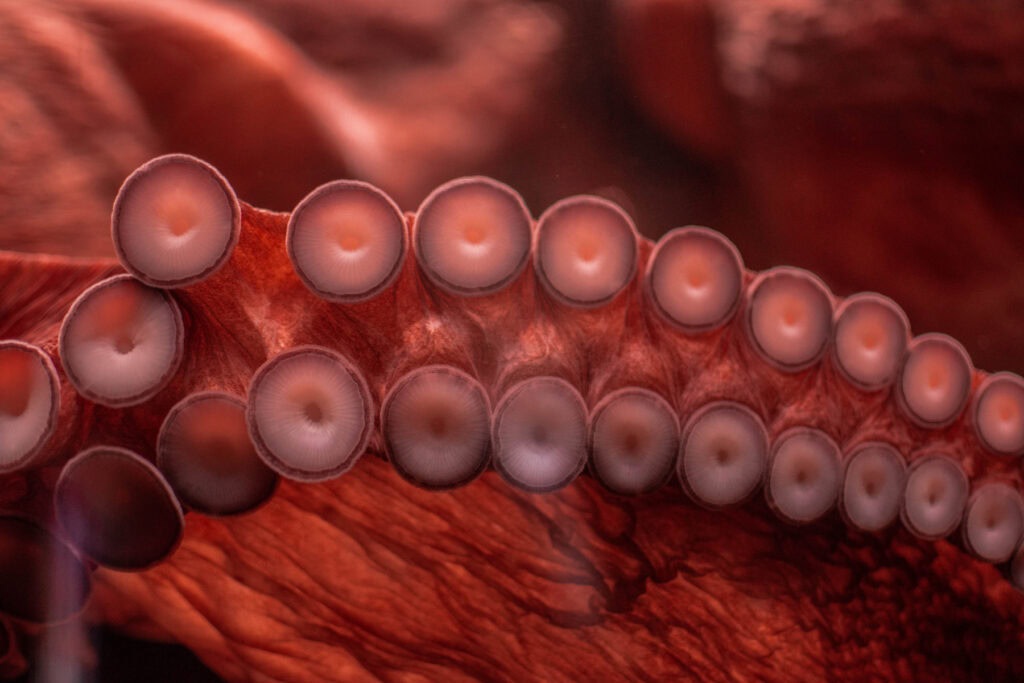
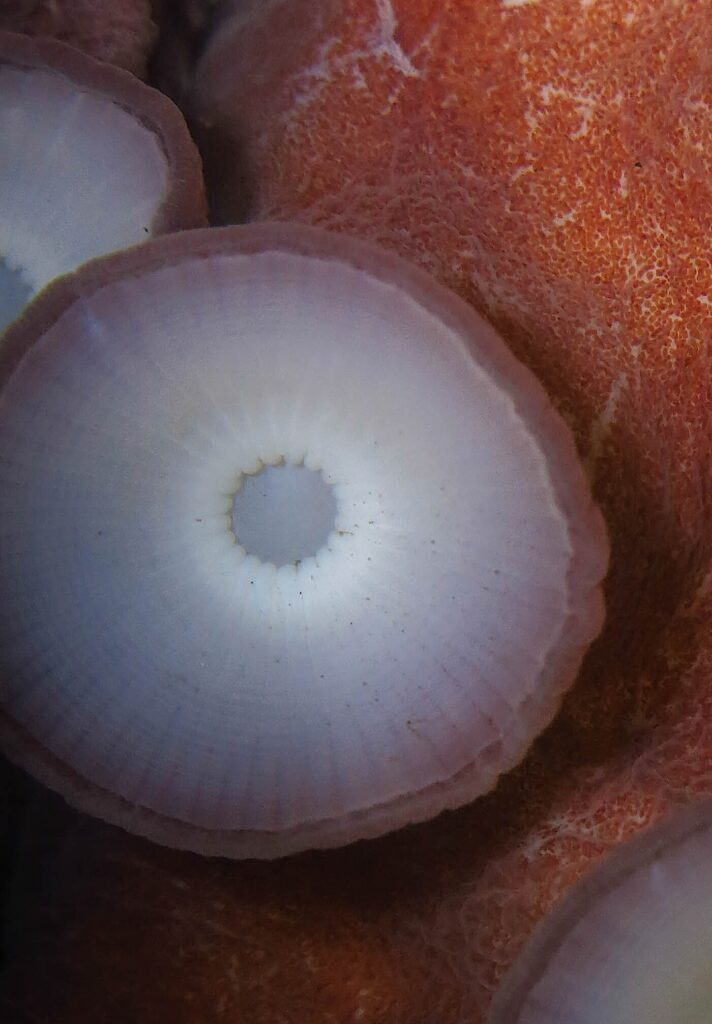
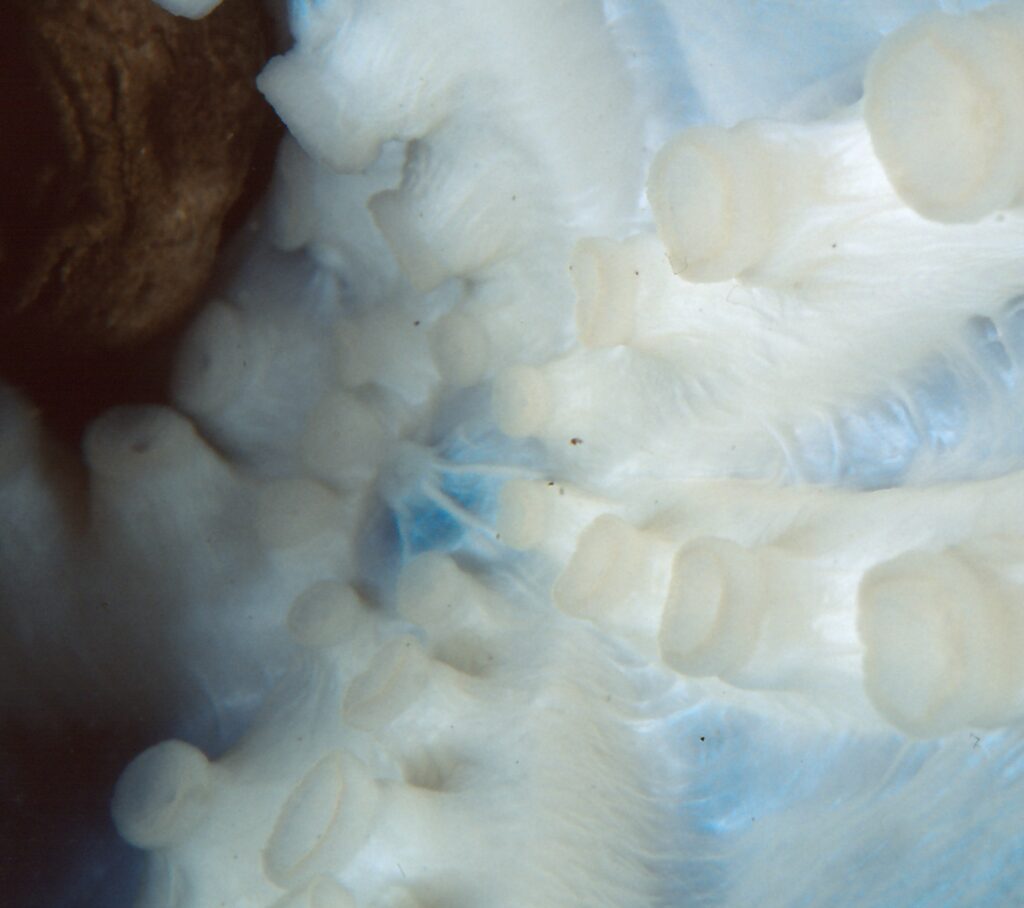
Octopuses’ (and other cephalopods’) arms are lined with suckers usually arranged in two parallel rows. Each one looks like a tiny suction cup with a bell-shaped center.
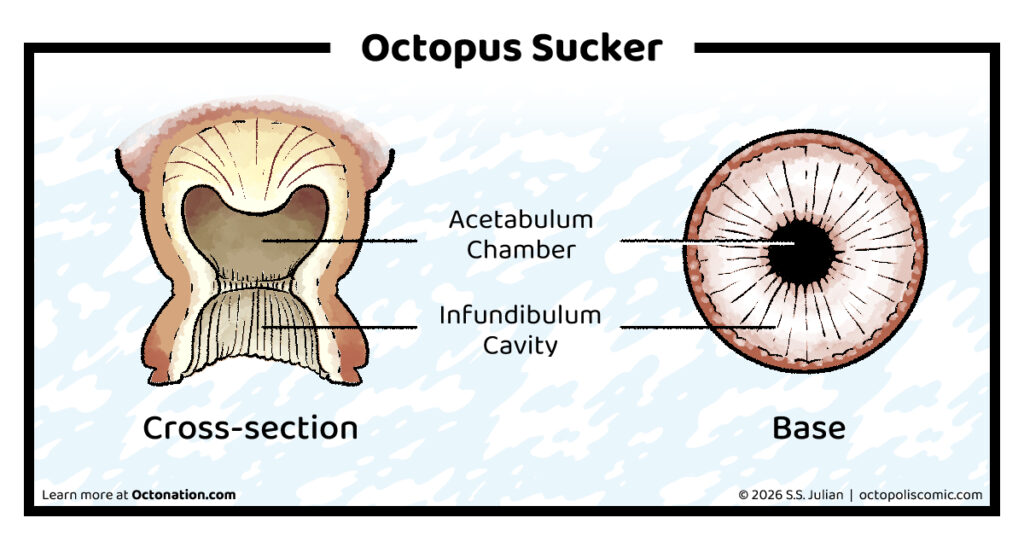
The suckers work like little plungers. When the octopus presses the suckers against a surface, it creates a vacuum seal that lets it stick tightly whether it’s holding a rock or grabbing prey.
These suckers aren’t smooth — they have ridges, which help them create that strong seal to grip all kinds of surfaces.
Octopuses can control each of these suckers individually, using them to move food into their mouth, but also to touch and taste their environment, thanks to special sensory cells. It’s like they have fingers and taste buds working at the same time!
Male and Female
Octopus Reproductive Anatomy: The Hectocotylus, Spermatophores, and Sexual Dimorphism
Male and female octopuses often look similar in appearance, but there are surprising exceptions. For example, in blanket octopuses, the female can grow up to 2 meters (over 6 feet) long, while the male is only about 2.4 centimeters, roughly the size of a walnut. This pair represents the most extreme sexual size-dimorphism in any non-microscopic animal.
In most octopus species, the easiest way to tell a mature male apart is by his hectocotylus.
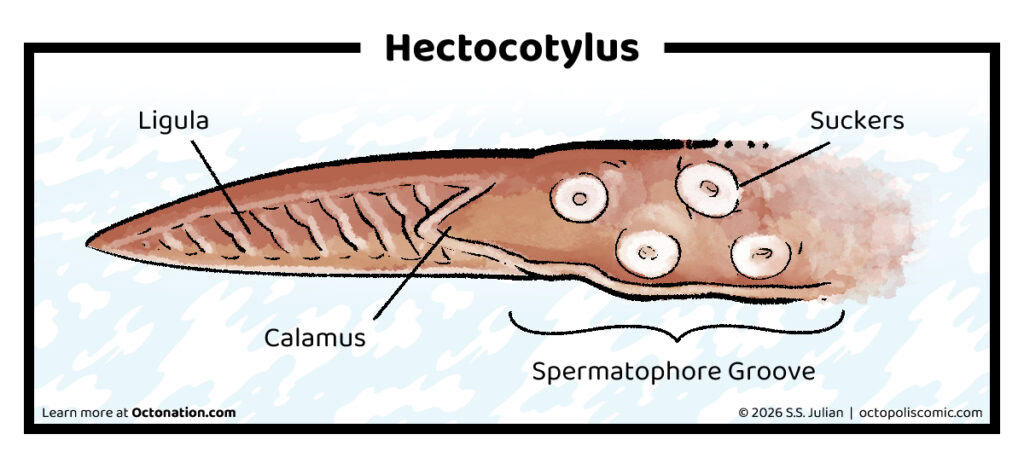
Note: The male’s hectocotylus can vary widely by species, so this illustration is just one example of what the different parts might look like.
In most male octopuses, the hectocotylus is the third arm on the right side, counted from the front. In some species, it appears on the left instead.
Male octopuses produce sperm packets called spermatophores. During mating, the spermatophore packet is transported to the hectocotylus. The hectocotylus has a groove along its underside that guides the spermatophore down the arm, like a conveyor belt. At the tip, a sucker-less region with structures called the calamus and spoon-shaped ligula helps deliver it into the female’s mantle, where her reproductive organs are located.
The Eyes Have It
Octopus Eye Anatomy: Pupil, Iris, Cornea, and Independent Eye Movement
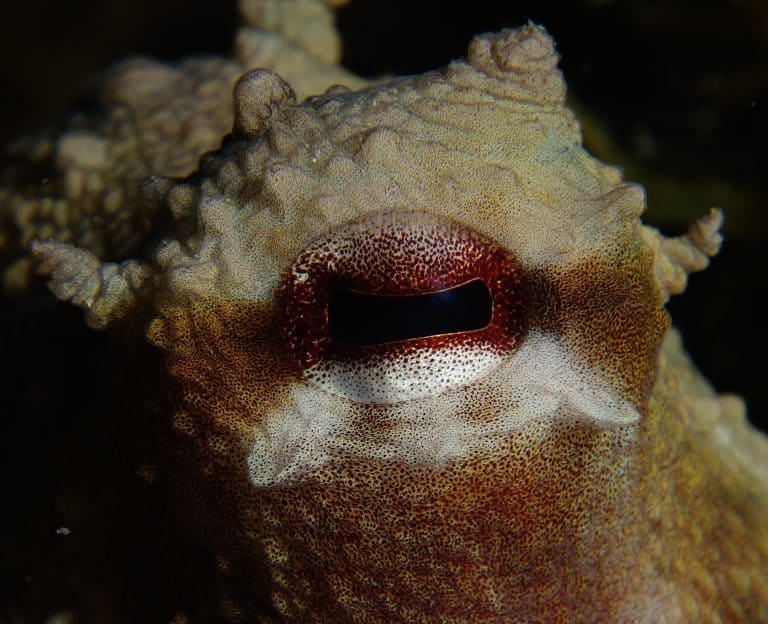
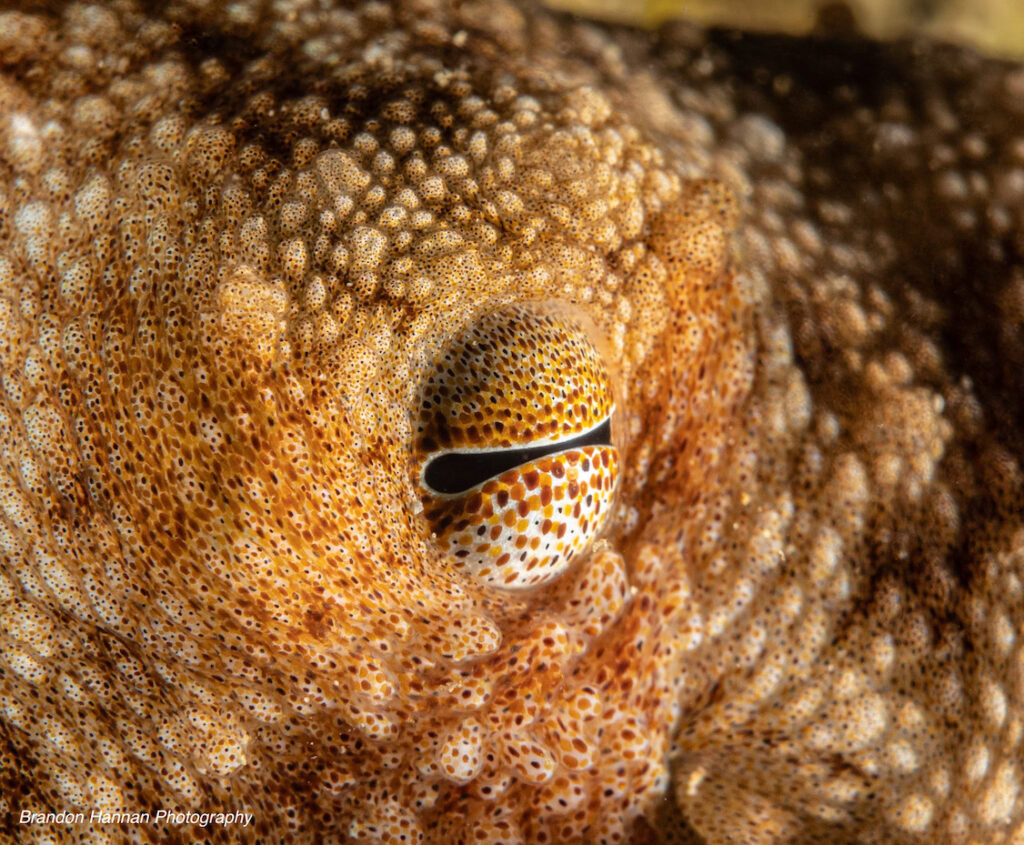
Octopuses have highly advanced camera eyes — very similar to our own.
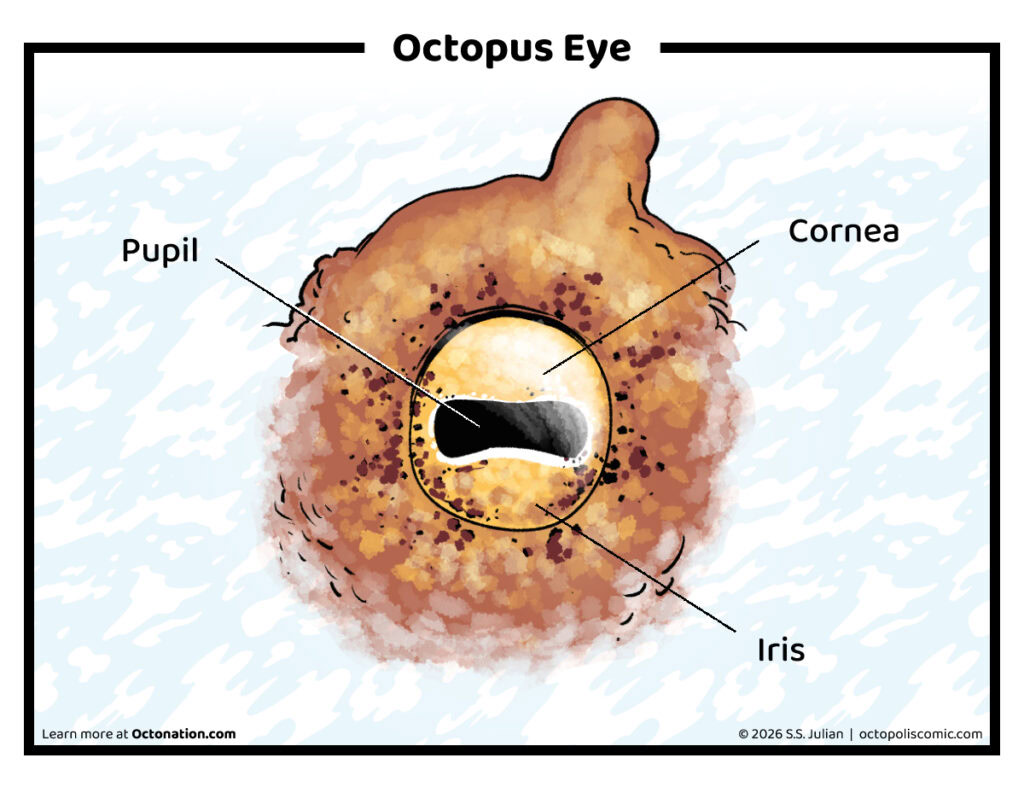
Like humans, they have a pupil (the opening that lets light in), a flexible iris, that controls how much light enters, and a transparent cornea, a clear outer layer that protects the eye and helps focus light. But there are some key differences.
In many octopus species, pupils are horizontal and the eyes sit high on the sides of their head. This gives them a wide, panoramic view, perfect for spotting prey and keeping an eye out for predators at the same time. And unlike us, they rely almost exclusively on monocular vision. Each eye processes its view separately, without combining them into a single stereoscopic image. The two eyes can also move independently, sometimes pointing in completely different directions at once. Think of a security guard watching two different monitors at once. While we have to turn our heads to shift focus, an octopus can watch a crab on the left AND scan for a predator on the right, at the same time.
Inside the Octopus
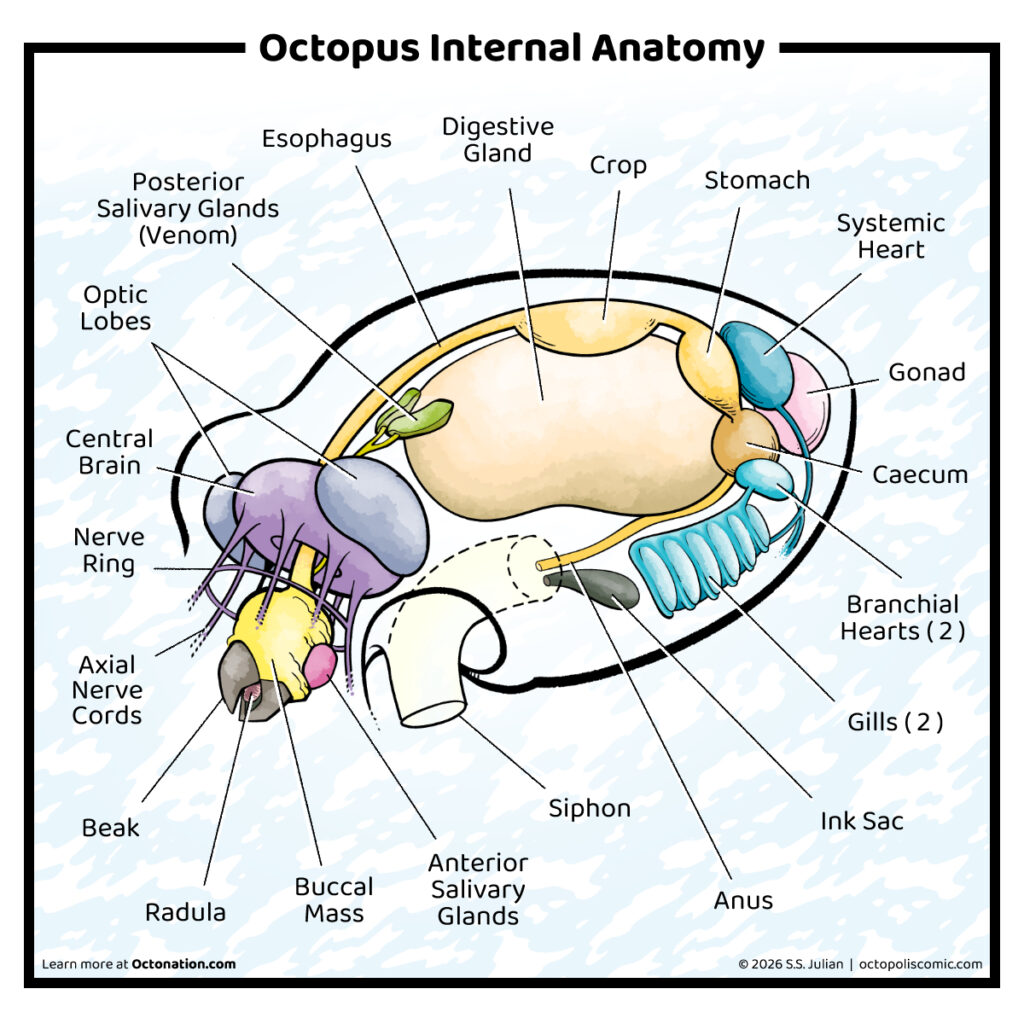
Octopus Internal Anatomy at a Glance
Let’s take a closer look inside the octopus, starting with the mantle and siphon.
Where Internal Meets External: The Mantle and Siphon
Anatomy of Respiration and Jet Propulsion
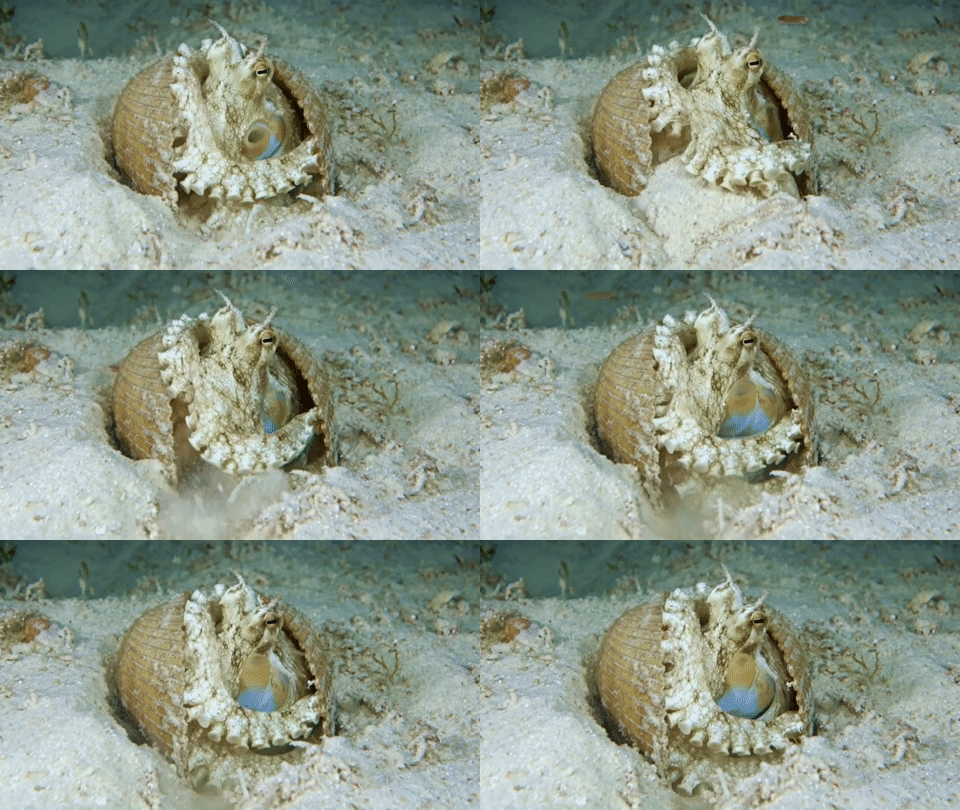
One characteristic of all mollusks (including octopuses) is the muscular tissue called the mantle. The octopus’s mantle is attached to its head and is typically tubular in shape. It acts like a pump for respiration and jet propulsion, and it also protects the vital organs located inside the mantle cavity.
Sticking out of the mantle cavity is a snorkel-like tube called the siphon or funnel. An octopus pulls water into the mantle cavity, then forcefully expels it out the siphon. As the water passes by the gills inside, the octopus takes in oxygen, making it essential for respiration.
A burst of water expelled from the siphon creates jet propulsion, helping the octopus zoom away from danger. The siphon is flexible, and can also act like a steering nozzle, allowing the octopus to change direction as it swims.
Lastly, the siphon serves as the exit for waste and ink. Just like their arms, the siphon is a multipurpose tool: part snorkel, part jet engine, and part exhaust pipe.
Stranger Things: Mouth Parts
Octopus Beak, Radula, and Salivary Glands (How an Octopus Eats)
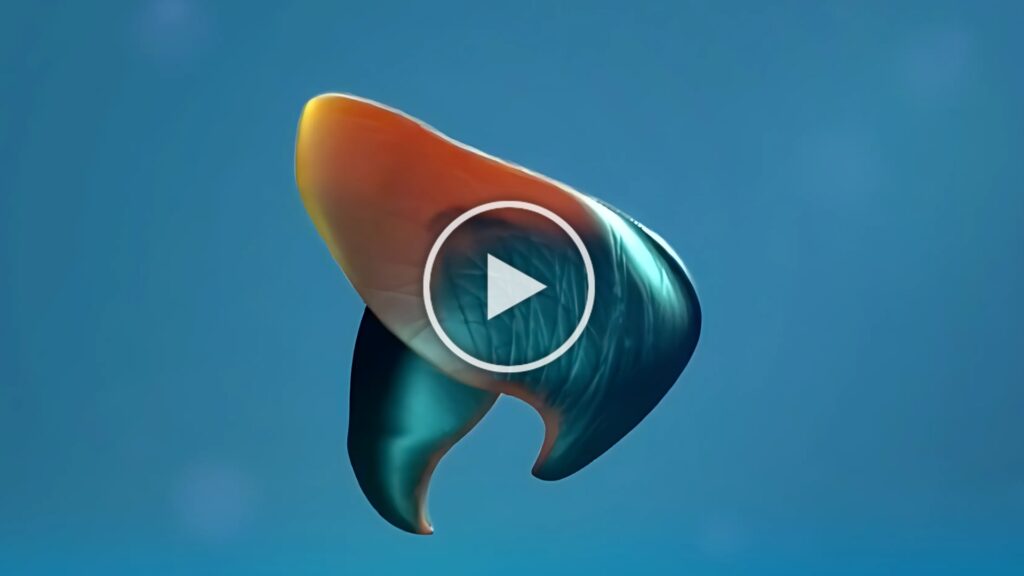
At the center of the octopus’s arms is its mouth. The mouth sits in a muscular structure called the buccal mass, which is part of the digestive system and connects to the esophagus. The buccal mass includes the mouth, beaks, radula, muscles, and salivary glands.
Equipped with a hard, parrot-like beak made of chitin (the same tough material found in insect exoskeletons), octopuses can crack open the shells of crustaceans and molluscs, including crabs and snails.
Between the upper and lower beaks, is the octopus’s radula. This is a ribbon-like tongue equipped with tiny teeth that moves up and down, so the octopus can grind up its meal.
Octopuses are also equipped with two pairs of salivary glands.The anterior salivary glands are on each side of the buccal mass and secrete mucus to aid in lubrication and food digestion. The posterior salivary glands are adjacent to the esophagus or crop and produce toxins (cephalotoxins). These glands deliver toxins through the octopus’s saliva, helping paralyze prey before it is eaten.
Brain Power
Octopus Brain Anatomy: Central Brain, Optic Lobes, and 500 Million Neurons
Octopuses have an incredibly complex nervous system, with, with around 500 million neurons and the largest brain of any invertebrate. .The system includes a central brain and an extensive peripheral nervous system distributed throughout their arms. This massive network, along with its unusual structure, is what makes them such impressive problem-solvers.
Traveling from the mouth to the head, you’ll find the octopus’s central brain, located between its eyes. It’s shaped like a donut, wrapping all the way around the esophagus! Next to the brain are two optic lobes for visual processing.The optic lobes are so important that they have more neurons than the central brain itself.
Most of the neurons in an octopus — about two-thirds — aren’t located in the head at all. Instead they are distributed throughout the arms. Extending from the central brain, axial nerve cords run down each arm. These cords are connected by a nerve ring, enabling signals to pass directly from arm to arm. Imagine the nerve ring as a group chat: the arms can coordinate directly without waiting for the central brain to respond. Arm 3 can tell Arm 5 “I found a crab!” without sending the message up to headquarters first. This arrangement allows the arms to coordinate movement and respond rapidly, bypassing the central brain entirely for faster motor control.
Why we do this. Research-backed ocean education like this piece is possible because OctoNation is a nonprofit. We run on the curiosity and generosity of supporters like you. If you’ve learned something today, help us keep the research flowing by donating here.
Hearts and Gills: Pump It Up
How Many Hearts Does an Octopus Have? The Three-Heart Circulatory System
Octopuses have not one, but three hearts!
Two of them, called branchial hearts (also called gill hearts), pump blood through the gills to pick up oxygen. The third, acts like the systemic (main) heart that sends oxygen-rich blood throughout the rest of the body. It’s a team of pumps that keeps everything running!
Unlike humans, octopus blood uses a copper-based protein called hemocyanin to carry oxygen instead of iron-based hemoglobin. Hemocyanin is dissolved directly in the blood, rather than contained in special cells like hemoglobin in red blood cells. Because of the copper base, their blood turns blue when oxygenated instead of red.
Another important feature of the octopus is that they have a closed circulatory system, meaning their blood travels through blood vessels — arteries, veins and capillaries — just like ours. This is different from lots of other molluscs, including clams and snails, that have an open circulatory system.

Ink-credible Escape
Octopus Ink Sac: How Octopus Ink Works
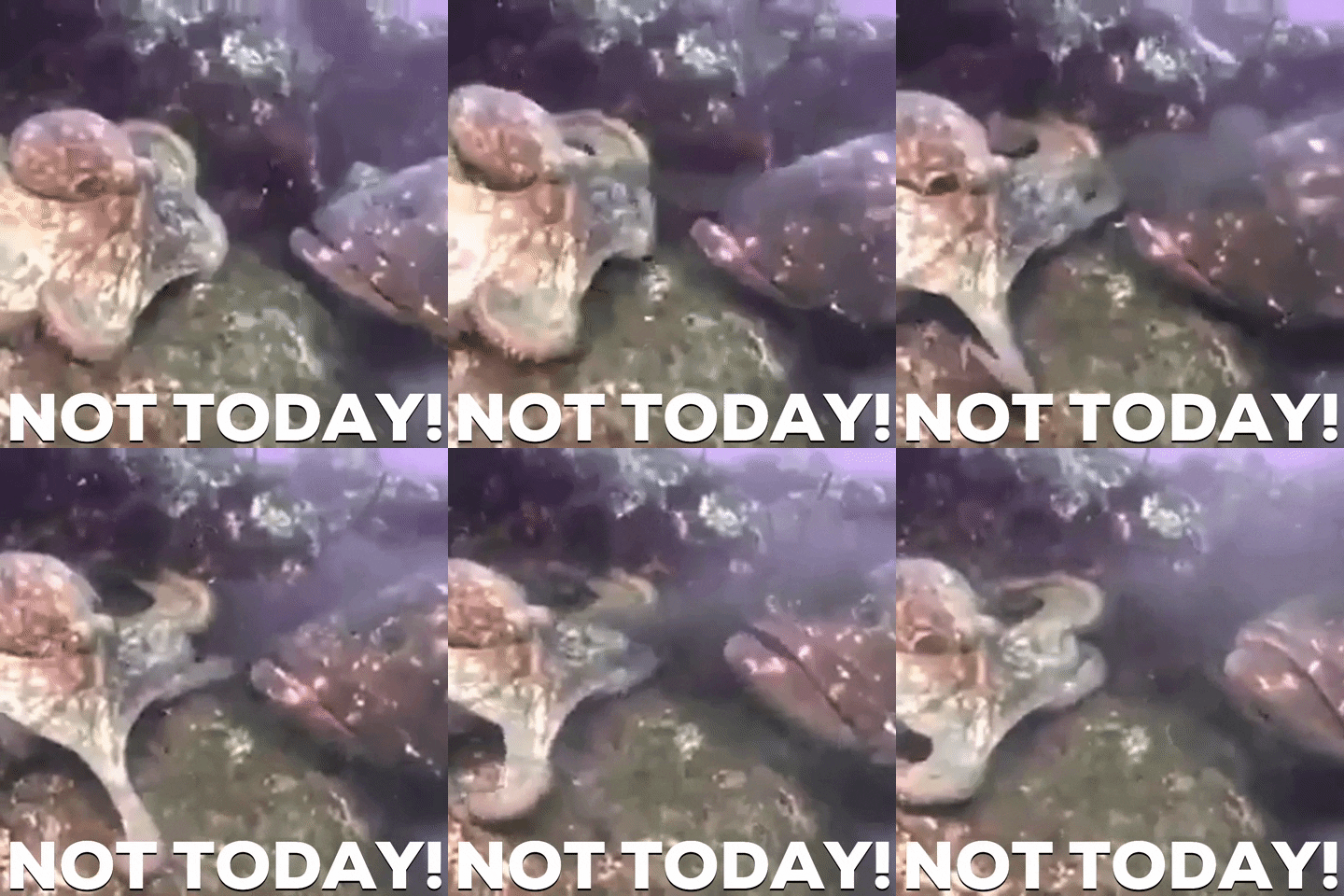
If an octopus needs to escape a predator, it can release an ink cloud to distract or confuse it, like an underwater smoke screen.
Ink is a combination of a dark pigment, called melanin, and mucus. Melanin is produced in the ink sac by the ink gland and mucus comes from the funnel organ.
When the octopus is ready to deploy it, the ink is injected into the anus, mixed with mucus, then ejected through the siphon.
The result? A smoky, inky cloud that can hide the octopus as it quickly swims away.
Eat, Digest, Repeat
Octopus Digestive System Step-by-Step
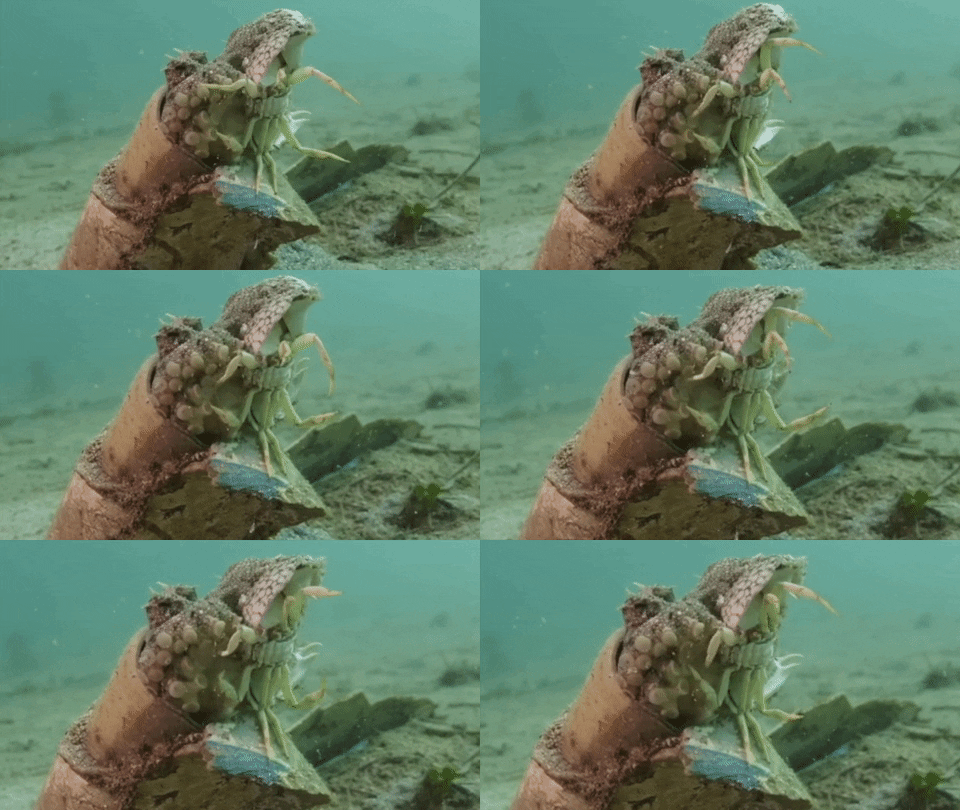
Digestion for an octopus starts outside the body. When it captures prey, it injects a digestive enzyme from its salivary gland to begin breaking the food down.
Once the food is ready, it is eaten and travels down the esophagus, which surprisingly, passes right through their donut-shaped brain!
Next it moves to the crop, a storage chamber that acts like a food holding tank, allowing the octopus to eat quickly, which is a must for an animal with high metabolism and energy needs. While in the crop, food mixes with enzymes and turns into a jelly-like substance. From there, the food continues through the stomach, caecum, and digestive gland where nutrients are absorbed and processed. Finally, waste moves to the anus and is expelled through the siphon.
The Birds and the Bees – Ovaries & Testes
Octopus Reproductive System: Gonads, Gametes, and Hormones
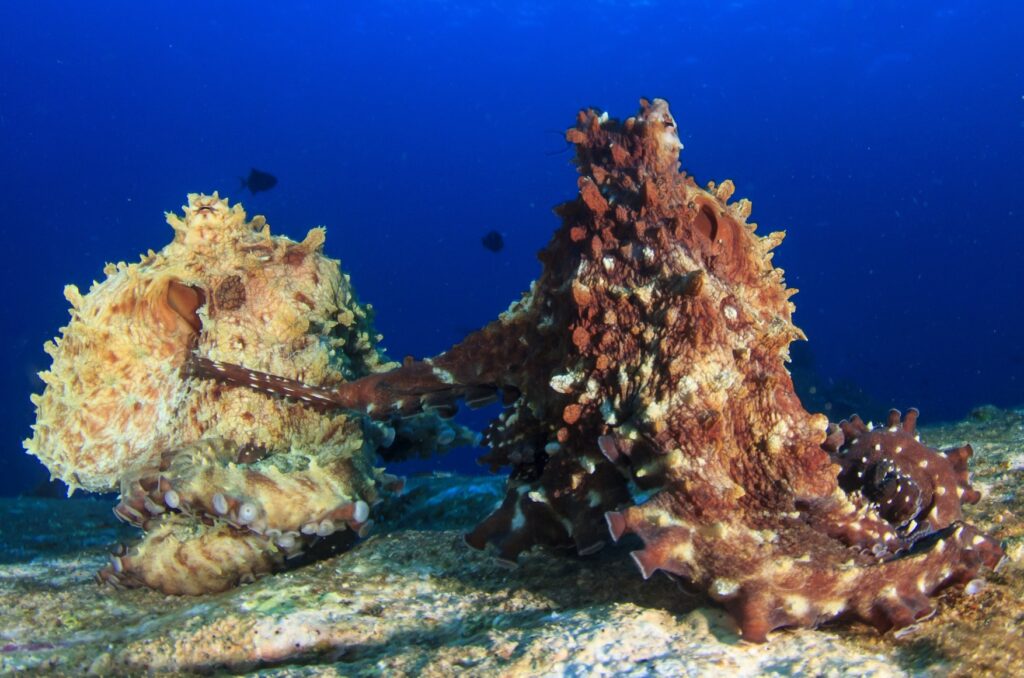
The gonads are the body parts responsible for producing sex cells, called gametes, and passing on genetic information to offspring.
In males, they develop into testes, which produce sperm. In females, they develop into ovaries, which produce eggs. While their structures differ, both serve the same essential role in reproduction and also produce hormones.
In male octopuses, these hormones play a key role. One specialized arm, called the hectocotylus, is sensitive to female hormones and helps the male locate and transfer packets of sperm (spermatophores) to the female’s reproductive organs.
Octopuses – They’re Endlessly Fascinating!
And with that we’ve explored octopus anatomy from ceph to pod (head to foot). Three hearts. Nine brains. Eight arms. Blue blood. A body that tastes the world through its skin and thinks partly through its limbs. are endlessly fascinating. If you’re looking for a deeper dive into any specific body parts, check out the links below, And if you’d like to commemorate this tour of the octopus, you can get your very own octopus anatomy poster!
Keep the ocean education coming OctoNation exists because the world deserves to know how incredible octopuses really are! We’re a nonprofit, and every guide, every research update, and every piece of art we share is made possible by the people who believe in this mission! Support OctoNation today, and keep the wonder flowing.
Octopus Anatomy: Thank you for Reading!!!
This poster & article exists because of the brilliant humans who collaborated to make it.
Dr. Chelsea Bennice, Ph.D. co-wrote this blog and spent months working alongside illustrator SS Julian on the gorgeous anatomy poster you’ve seen throughout. Dr. Bennice is a cephalopod biologist whose research focuses on octopus behavior, ecology, and camouflage.
OctoNation founder Warren Carlyle added some humor, analogies, and the lighthearted fun that turns octopus science from a textbook into wonder & curiosity.
Bethany Augliere, M.S., a marine biologist, ocean photographer, and science journalist, served as editor as we wrapped up the project.
If you learned something today, chip in to keep OctoNation free, fact-checked, and full of wonder. Donate to OctoNation
Who is the Octopus Anatomy Artist?!
The one and only SS Julian, author of the comic Octopolis! His comic is a science-fiction about a future society of intelligent octopuses. Through fiction, he wanted Octopolis to be as authentic and educational as possible, so he learned as much as he could about the unique biology and behavior of the octopus to write and illustrate the story.
If you’re a fan of octopuses (and if you’re here on Octonation, you must be), you’ll probably enjoy Octopolis! Pick up your copy here!
Octopus Anatomy: Frequently Asked Questions
Not quite a full brain, but close enough that it’s mind-blowing. Each arm has an axial nerve cord packed with ganglia that act as a local processor, handling reflexes and fine motor control without needing instructions from the central brain (Young, 1963). The arms are also linked to each other by a nerve ring, so they can coordinate directly, like a group chat that skips headquarters.
Officially, Octopus vulgaris — but there’s a taxonomic twist. Recent molecular and morphological work showed that what scientists historically called “O. vulgaris” worldwide is actually a species complex of multiple cryptic species. According to that paper, O. vulgaris sensu stricto (the “true” common octopus) is restricted to the Mediterranean Sea and eastern North Atlantic. Other regions — the Caribbean, the western South Atlantic off Brazil, eastern Asia, and others — are now recognized as separate species or distinct lineages. So when this guide refers to “the common octopus,” we mean O. vulgaris sensu stricto.
Arms. Specifically, eight of them. People mix this up constantly because we use “tentacles” loosely in everyday English, but in cephalopod biology the words mean different things. Arms have suckers running along their entire length. Tentacles are mostly bare structures with suckers concentrated at a paddle-shaped tip called the club. Squid and cuttlefish have 8 arms PLUS 2 tentacles. Octopuses have just the 8 arms — every one a multi-tool. Read more on arms vs. tentacles.
A modified arm in male octopuses, used to transfer sperm packets (spermatophores) to the female during mating. In Octopus vulgaris, it’s the third right arm, with a groove along its underside that guides the spermatophore toward the tip and a sucker-less region at the end (with structures called the calamus and ligula) that helps deliver the spermatophore into the female’s mantle. The strangest version belongs to argonauts (paper nautiluses): the male’s hectocotylus actually detaches during mating, and the female stores the freed arm inside her mantle cavity, sometimes alongside hectocotyli from multiple males.
No external ears, but they can detect underwater vibrations. Inside the head sit two tiny organs called statocysts, primarily equilibrium sensors (think of them like an inner-ear balance system, but for octopuses). In one study, Octopus vulgaris responded to vibrations between 1 and 100 Hz in seawater by sensing particle motion, the back-and-forth movement of water molecules, rather than sound pressure. Scientists still debate whether to call this “hearing” the way we mean it for vertebrates. Either way, octopuses do sense the vibrations of their underwater world!
Yes…two of them, tucked inside the mantle cavity. Water flows IN through the openings under the mantle and OUT through the siphon, that snorkel-like tube poking out of the body. As water passes the gills, oxygen moves into the blood and waste gets carried out. That same siphon can also act like a jet—blasting water out to power a quick escape… and yes, it handles waste too. 💩 Read more on how octopuses breathe.
Blue, when it’s oxygenated. Octopuses carry oxygen using a copper-based protein called hemocyanin, instead of the iron-based hemoglobin we vertebrates use. The copper is what turns the blood blue when it picks up oxygen at the gills. Unlike our hemoglobin, hemocyanin floats freely in the plasma rather than being packed inside red blood cells.
Not bones, no. But they’re not 100% squish either. Early anatomical work (1929) found the only real “skeletal” pieces are small cartilages in the head and tiny dorsal stylets…leftovers from an ancient internal shell. If you flick your ear or rub your nose, that’s about as protective as cartilage gets. They’ve also got a hard chitin beak for crunching prey! The rest of the body runs on a muscular hydrostat: fluid-packed muscle that holds its shape while bending, stretching, and squeezing through just about anything. Read more on the no-bones body plan.
Technically, octopuses have one central brain…but their nervous system is so distributed it’s often described as having “nine brains.” In Octopus vulgaris, there are roughly 500 million neurons, with the majority (60%) located in the arms. Each arm contains a large axial nerve cord and ganglia that can process information and control movement locally, almost like built-in processors, while the central brain coordinates overall behavior. TLDR…It’s not nine brains…it’s one brain running eight highly capable outposts. Read more on octopus brains.
Three! Two branchial hearts (also called gill hearts) push blood through the gills to pick up oxygen, and one systemic heart pumps the freshly oxygenated blood out to the rest of the body. Think of it like a relay team: the branchial pair handles the gills, the systemic heart handles everything else. Read our deep dive on octopus hearts.
Continue Exploring Octopus Anatomy!
How an Octopus Lost its Shell: Read more here.
Octopuses are Invertebrates: Read more here.
Octopuses Color-Changing Skin: Read more here.
Call to Arms: Read more about arms here and suckers here.
No Bones, No Problem – Muscular hydrostats: Read more here.
The Eyes Have It: Read more on octopus eyes here.
Stranger things, Mouth parts: Read more on octopus beaks and radula here.
Brain Power: Read more on octopus brains here.
Hearts and Gills, Pump it Up: Read more about the octopus siphon and respiratory system here.
Ink-credible Escape and Defensive Behaviors: Read more here.
Eat, Digest, Repeat: Read more on octopus beaks here and what an octopus eats here.
Octopus Mating: Read more here
References
- Bennice, C.O., Buresch, K.C., Grossman, J.H., Morano, T.D., & Hanlon, R.T. (2025). Octopus arm flexibility facilitates complex behaviors in diverse natural environments. Scientific Reports, 15(1), 31875. https://doi.org/10.1038/s41598-025-10674-y
- Byrne, R.A., Kuba, M., & Griebel, U. (2002). Lateral asymmetry of eye use in Octopus vulgaris. Animal Behaviour, 64(3), 461–468. https://doi.org/10.1006/anbe.2002.3089
- Cariello, L., & Zanetti, L. (1977). α- and β-cephalotoxin: Two paralysing proteins from posterior salivary glands of Octopus vulgaris. Comparative Biochemistry and Physiology Part C: Comparative Pharmacology, 57(2), 169–173. https://doi.org/10.1016/0306-4492%2877%2990066-1
- Chung, W.-S., Kurniawan, N.D., & Marshall, N.J. (2022). Comparative brain structure and visual processing in octopus from different habitats. Current Biology, 32(1), 97–110.e4. https://doi.org/10.1016/j.cub.2021.10.070
- Hanke, F.D., & Kelber, A. (2020). The eye of the common octopus (Octopus vulgaris). Frontiers in Physiology, 10, 1637. https://doi.org/10.3389/fphys.2019.01637
- Kier, W.M., & Stella, M.P. (2007). The arrangement and function of octopus arm musculature and connective tissue. Journal of Morphology, 268(10), 831–843. https://doi.org/10.1002/jmor.10548
- Marmolejo-Guzmán, L.Y.G., Castellanos-Martínez, S., Bennice, C.O., Carlyle, W.K., & Aguirre-Macedo, M.L. (2025). Parasites: The hidden hitchhikers of cephalopods. Frontiers for Young Minds, 13, 1426702. https://doi.org/10.3389/frym.2025.1426702
- Norman, M.D., Paul, D., Finn, J., & Tregenza, T. (2002). First encounter with a live male blanket octopus: The world’s most sexually size-dimorphic large animal. New Zealand Journal of Marine and Freshwater Research, 36(4), 733–736. https://doi.org/10.1080/00288330.2002.9517126
- Peterson, K.J., Lyons, J.B., Nowak, K.S., Takacs, C.M., Wargo, M.J., & McPeek, M.A. (2004). Estimating metazoan divergence times with a molecular clock. Proceedings of the National Academy of Sciences, 101(17), 6536–6541. https://doi.org/10.1073/pnas.0401670101
- Young, J.Z. (1963). The number and sizes of nerve cells in Octopus. Proceedings of the Zoological Society of London, 140(2), 229–254. https://doi.org/10.1111/j.1469-7998.1963.tb01862.x

Meet Dr. Chelsea Bennice — marine biologist, postdoctoral research fellow at Florida Atlantic University’s Marine Lab, and the person the local diving community nicknamed “Octo-Girl” after she logged over 1,000 hours underwater studying octopuses. Across 10+ years of research, her “octo-topics” have spanned behavior, skin microbiome, genetics, and morphology. Chelsea earned her M.S. and Ph.D. at FAU and serves as a lead scientific diver and board member for FAU’s Scientific Diving and Boating Safety Committee. She’s a fierce advocate for bridging scientists and the public — which is exactly why she’s OctoNation Science Advisor!